By JEFF LAMPE
For The Weekly Post
The early-March day was chilly and windy, cold enough to bring to mind the old idiom about a well digger.
The cold didn’t bother Doug Cosby, who was in fact digging a well near London Mills on that chilly day. But mud is another matter. So a prediction of incoming rainstorms had him working in the cold.
“I love digging wells, but I hate mud,” Cosby explained. “I don’t like to work in muddy conditions just because it’s a lot of extra work and, from a safety standpoint, you can slip.”
There’s not much else Cosby, 61, dislikes about digging wells. Actually, he enjoys the process so much he went full time after retiring in 2022 following a 33-year career as a Caterpillar Inc. engineer.
“I like meeting new people. I love the thrill of getting them water,” he said. “And I love to work on stuff. We make a lot of our own tooling.”
Not long after he expanded his business, Cosby was joined by his son Josh, 26, the fourth generation of Cosbys to drill wells. Doug and wife Terri have three children, but eldest son Max and daughter Anney pursued other careers.
So it’s up to Josh and Doug to follow a path blazed by the father-and-son duo of Edward Leo Cosby and Edward Leo Cosby Jr., the former longtime mayor of Elmwood.
“Believe it or not, my grandpa Ed started this when he bought a house out in the country (near Brimfield) and it needed a well,” Doug said. “He wanted to drill his own well, so he bought a Cable Tool drill rig mounted on an old school bus.”
Ed Jr. followed in his dad’s footsteps and, after working in the Air National Guard and at the Peoria Journal Star, got enough wells to dig so he could leave other jobs behind.
During high school and college, Doug helped his father and also worked at Jordan’s Mobil in Elmwood, where he learned plenty about customer relations from the late Dave Jordan. After graduating from Bradley University with an engineering degree, he took a job with Cat. About 12 years ago, he started digging wells on weekends.
And while his 87-year-old father now lives in a Peoria assisted-living facility and is no longer a regular at job sites, Doug said his father is still keenly interested in the business.
“Every time I go to visit him, over half the time is talking about well drilling,” Doug says. “And I call him about every job I do or am going to bid.”
It was also the eldest Cosby’s advice to get Josh involved after he finished at Illinois State University. So far so good. The youngest Cosby well digger said he enjoys the work and is in much better shape than when he started.
Plus, the future looks brighter than he envisioned while helping his father during summers in high school.
“When I was a teenager, my grandpa would ask, ‘Are you going to get into well drilling?’” Josh recalled. “I told him, ‘I enjoy it but I don’t see a career in it.’”
That has changed. AI is a real threat to the careers of many young people, but computers aren’t digging wells. Then again, nor are many other humans.
“Fifteen years ago when I went in to get my license, the room would be full of 700-800 people. I just went again in February and there were less than 200 people,” Doug said. “It has turned into an old man’s game.”
Integrating a younger perspective can be helpful.
“I’m an analog guy in a digital world and he’s the one bringing the digital world into the business,” Doug said. “And he’s really good at it. Where I’m becoming my dad maybe and doing things the hard way, he has suggestions to make things easier.”
Some changes are simple, like using a skid steer to load well casings and to help guide casings into the ground – jobs the older Cosbys did by hand.
But Josh is also looking into timed electromagnetism devices to help find underwater aquifers. The Cosbys do not use divining rods or “witching” to find water sources. And while Doug is generally very good at deciding where to dig, some help can’t hurt.
“What he’s bringing to the table is good, but sometimes I have to throttle him back a little and say, ‘Not now,’” Doug said.
Overall, the timing for fresh blood is good, since the past year has been busy for the Cosbys. Drought conditions are forcing many rural families with hand-dug wells to haul water and drive to town to do laundry – or pay to have deeper wells bored.
Older hand-dug wells are typically no deeper than 26 feet, Doug said. While that is adequate for normal conditions, the recent prolonged drought has made many wells run dry.
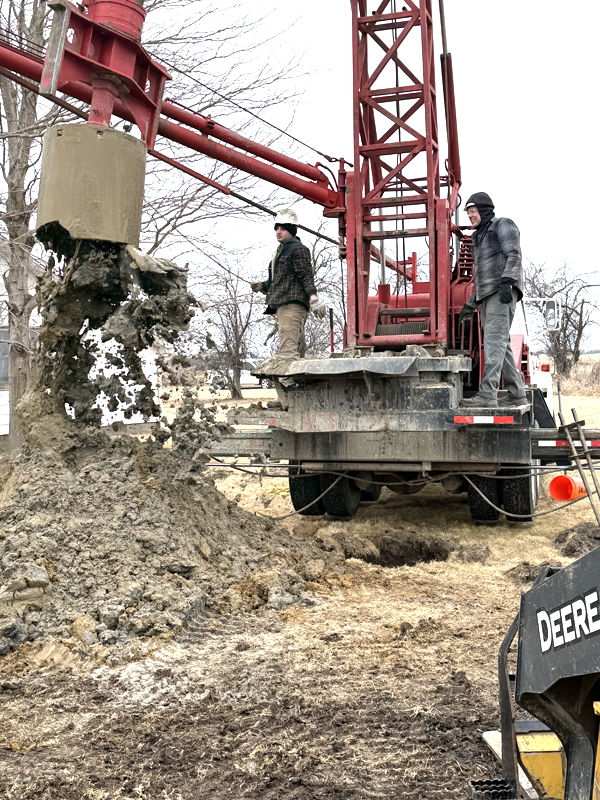
Doug uses his auger and buckets to bore a 45-inch-diameter hole up to 100 feet. Drilled wells can reach much deeper, up to 500 feet, but cost 21⁄2 times more, he said.
As a hole is formed, the Cosbys lower concrete casings into place. Cave-ins and boulders are the nemesis of well diggers.
After digging through topsoil, the auger works into brown clay, then gray clay and then reaches gray sand, coal or shale. That’s where the water usually is, Doug said, noting the average depth of his wells is 45-50 feet.
Once a good source of water is located, the Cosbys can also provide pumping systems, since Doug is licensed in both well drilling and pump installation, as were his father and grandfather. Josh is pursuing dual licensing and has exams in April.
Last year the Cosbys dug wells from May to Christmas. Most jobs are residential, but they are expanding into the commercial market.
And while wells are not cheap, Doug says they are an investment that can help improve the resale value of a home.